BAER (Brainstem Auditory Evoked Response) – Deaf Testing
Breeds commonly affected:
Congenital deafness is recognised as a problem in many dog breeds that mostly have a white coat (i.e. those that carry the extreme piebald gene). Such breeds include, but are not limited to:
- Dalmatians
- English Setters
- Border Collies
- Australian Shepherds
- White Boxers
- White Bull Terriers
Deafness has also been reported to be associated with the gene that causes the merle coat colour (mottled patches of colour in a solid or piebald coat, blue or odd-coloured eyes, and also possible effects of skin pigment). Examples of breeds with the merle coat are:
- Border Collies
- Australian Shepherds
- Dappled Dachshunds
- Old English Sheepdogs

Bull Terrier Club Heart Scheme
https://thebullterrierclub.org/ownership/health/
https://www.vet-cardio.co.uk/common-familial-heart-diseases-in-dogs/

Bull Terrier Club Kidney Scheme
FAMILIAL NEPHROPATHY – POLYCYSTIC KIDNEY DISEASE
The mode of inheritance of Kidney Diseases is not yet fully understood, however, there is a screening test available and whilst not conclusive, early signs are that this test would appear to show if an animal is likely to develop the disease in later life.

Chiara-Like malformation (CM)/Syringomyelia (SM) – CM is a condition characterised by a mismatch in size between the brain (too big) and the skull (too small) . This condition is so painful and has been described as trying to shove a brain the size of a 10 foot into size 6 shoe.
- www.bva.co.uk/canine-health-schemes/cmsm-scheme
- www.cavaliermatters.org/chiari-syringomyelia-introduction
Common breeds at risk
Chiari malformation/syringomyelia has been shown to be inherited in the Cavalier King Charles Spaniel and the Griffon Bruxellois and is suspected to be inherited in the King Charles Spaniel.
Other breeds reported with the condition include:
- Affenpinschers
- Boston Terriers
- Chihuahuas
- Havanese
- Maltese
- Papillons
- Pomeranians
- Staffordshire Bull Terriers
- Yorkshire Terriers
The Scheme is open to all dogs, including crossbreeds.

Echo Doppler exam for (SAS) (DCM) (PDA) – heart condition
https://www.vet-cardio.co.uk/common-familial-heart-diseases-in-dogs/
https://www.thenewfoundlandclub.co.uk/hearttesting.html
Subaortic stenosis (SAS): the most common form of aortic stenosis in dogs is subaortic stenosis (SAS), where a fibromuscular ring of tissue develops below the entrance to the aorta, the body’s main artery from the heart. Because of an increased pressure on the heart, the muscle thickens, becomes starved of oxygen because of its increased workload, and abnormal heart rhythms are commonplace. If these are not fatal in the first years of life, dogs with SAS can develop heart failure. Boxer dogs, Newfoundlands, the German Shepherd dog, English Bull Terriers and Pugs are predisposed to SAS, and we know that it is definitely heritable in Boxers and Newfoundlands
(DCM): Dilated cardiomyopathy is a degenerative disease of the heart muscle, which can lead to heart failure, abnormal heart rhythms, and sudden cardiac death. DCM is known to be inherited in the Doberman, Boxer dog, Great Dane, Newfoundland, Irish Wolfhound, Cocker Spaniel and the Portuguese Water Dog. It is believed to be inherited in many other breeds also, but scientific data on this is currently lacking.
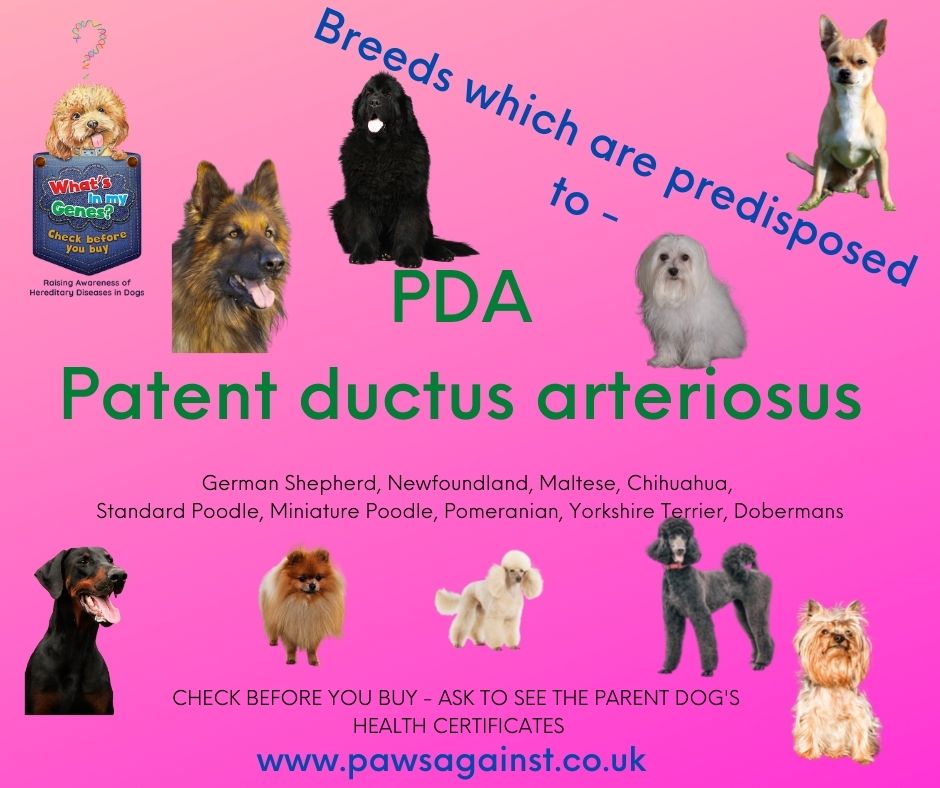
Patent ductus arteriosus (PDA): https://vetspecialists.co.uk/fact-sheets-post/patent-ductus-arteriosus-pda-fact-sheet/
Congential rather than hereditary. The ductus arteriosus is a blood vessel that is normally open in the foetus, and allows blood to bypass the lungs, which are not inflated in utero. In normal dogs, the ductus closes in the first days of life, owing to contraction of smooth muscle surrounding the vessel, in response to increased hormone levels around the time of birth. In some dogs, a lack of this smooth muscle leads to persistence of blood flow through the ductus – a patent ductus arteriosus (PDA). After birth, flow through a PDA overloads the lungs and the heart, and eventually leads to heart failure.
PDA may occur in any breed but some breeds have been shown to be predisposed:
- German Shepherd
- Newfoundland
- Maltese
- Chihuahua
- Poodle


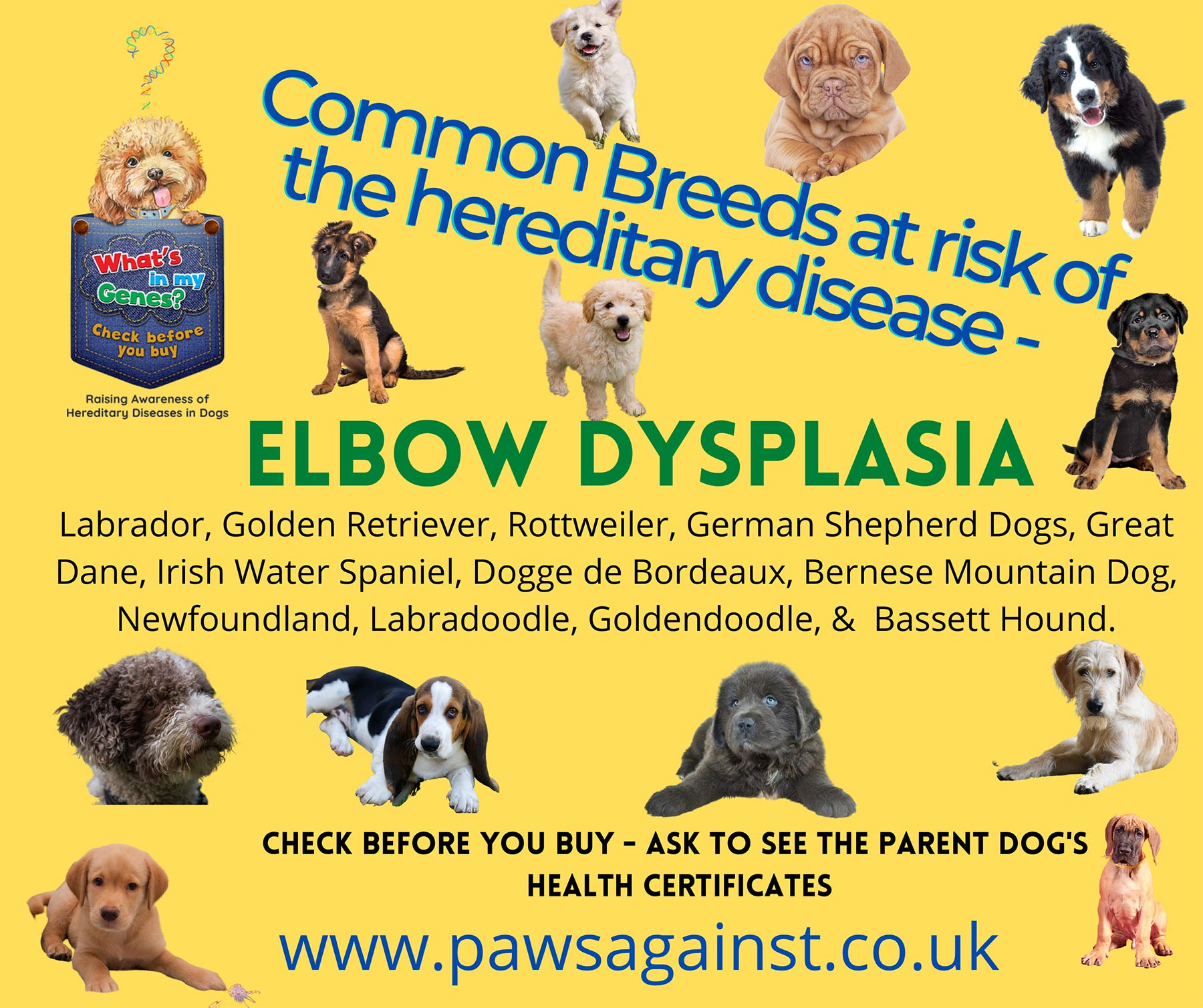
Elbow Dysplasia – a painful debilitating disease which can cause lameness, arthritis and in some cases necessitate an operation.
Really interesting video from Dr Mike Farrell discussing what causes Canine Elbow Dysplasia: https://youtu.be/U5L94cRKLlU
you can see more information on Elbow Dysplasia from Mike on his Vet Lessons site here: https://www.vetlessons.com/elbow-dysplasia
Excellent video from the CAMs https://caninearthritis.co.ukteam interviewing Geneticist Tom Lewis about ED &HD
Another video from Nancy Dear Veterinary Physiotherapist: https://youtu.be/39wDIpeIsLs
Common breeds at risk of Elbow Dysplasia
Elbow dysplasia affects a range of breeds including crossbreeds.
- Basset Hound
- Bernese Mountain Dog
- Dog de Bordeaux
- German Shepherd Dog
- Great Dane
- Irish Water Spaniel
- Newfoundland
- Goldendoodles
- Labradoodles
- Labrador Retriever
- Rottweiler
Many other breeds suffer from elbow dysplasia.
Haemophillia – GSD club Scheme test for males
This is a bleeding disorder, it is normally only MALES that are afflicted. Whilst it is possible for a female to have the disorder it is EXTREMELY rare.

Heart Scheme – Cavalier King Charles Spanie
The Kennel Club Heart Scheme assesses Cavalier King Charles Spaniels for mitral valve disease and other potentially significant heart diseases.
https://www.vet-cardio.co.uk/common-familial-heart-diseases-in-dogs/
https://www.cavaliermatters.org/unique-hereditary-diseases-index/mvd-heart-disease/

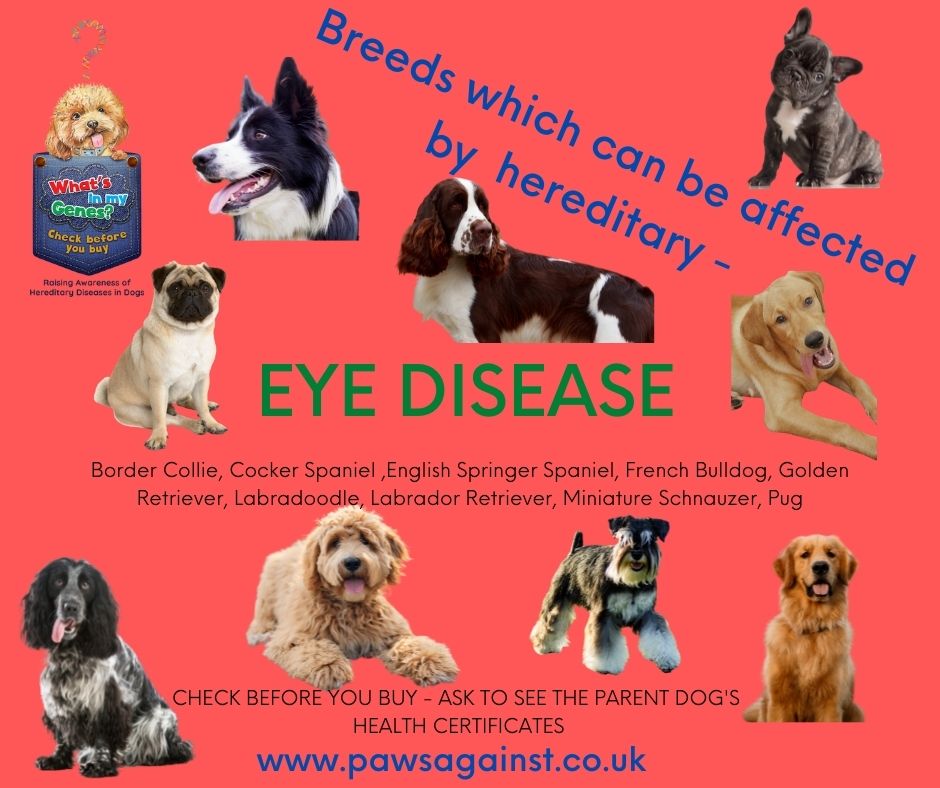
Hereditary Eye Disease – There are many types of hereditary eye disease, both congenital (conditions that exist from birth or soon after birth) and non-congenital (conditions that develop later in life), that affect dogs. Many of these conditions can have serious effects on health and welfare, causing pain, blindness, or the need for lifelong medication, and should be taken into consideration when breeding dogs.
All dogs, including crossbreeds are at risk of suffering from eye disease. Common breeds at risk are:
- Border Collie
- Cocker Spaniel
- English Springer Spaniel
- French Bulldog
- Golden Retriever
- Labradoodle
- Labrador Retriever
- Miniature Schnauzer
- Pug
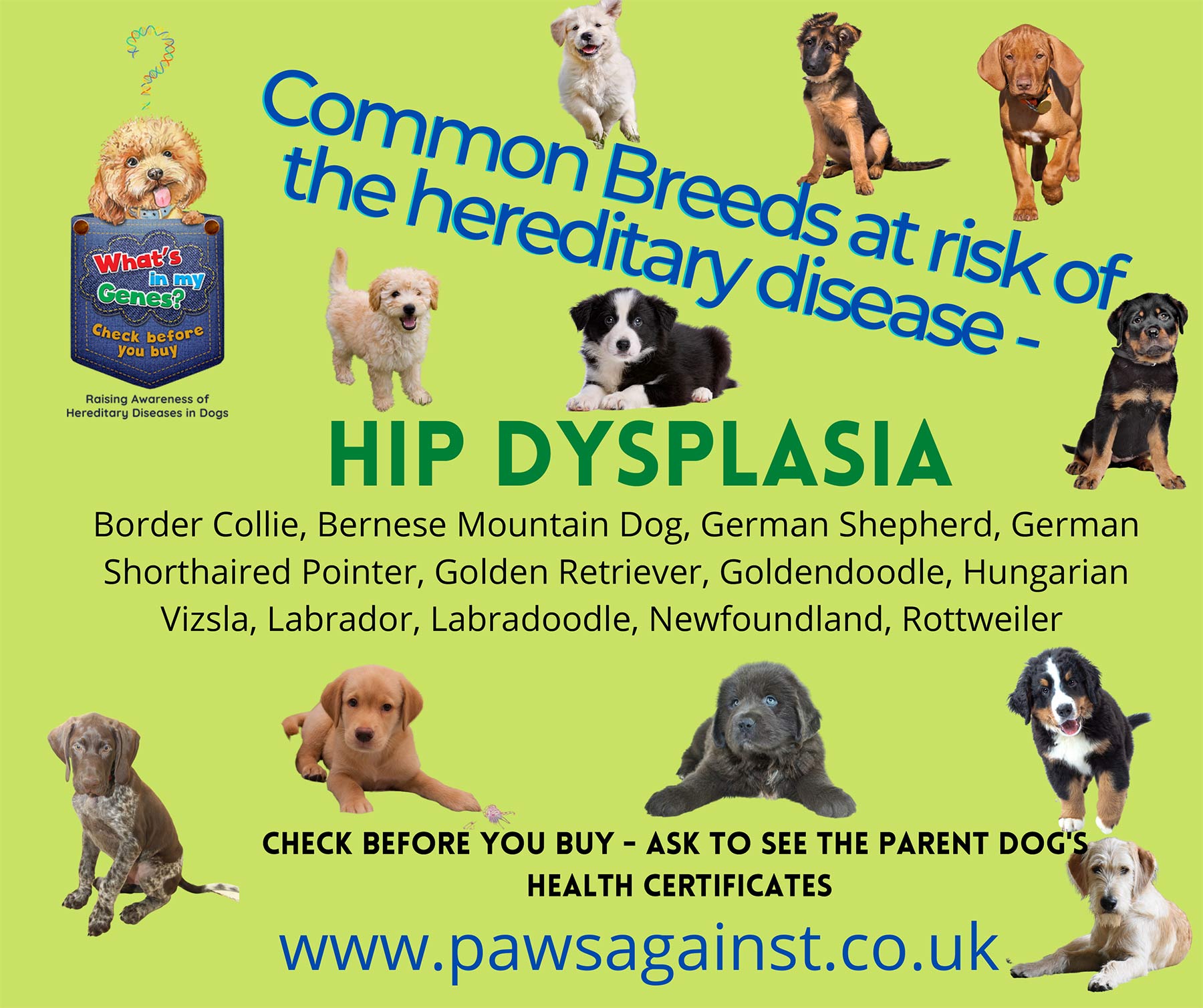
Hip Dysplasia – a painful debilitating disease which can cause lameness, arthritis and in some cases necessitate an operation.
Excellent Video from the team at CAMs https://caninearthritis.co.uk interviewing Tom Lewis a Geneticist about HD & ED https://youtu.be/Wg-EAaV-N4c
Another video from the amazing Nancy Dear Vet Physio https://www.vetphysionancy.com
Hip dysplasia affects a range of breeds including crossbreeds.
Common breeds at risk of hip dysplasia are:
- Border Collie
- Bernese Mountain Dog
- German Shepherd
- German Shorthaired Pointer
- Golden Retriever
- Goldendoodle
- Hungarian Vizsla
- Labrador Retriever
- Labradoodle
- Newfoundland
- Rottweiler
Many other breeds suffer from hip dysplasia.
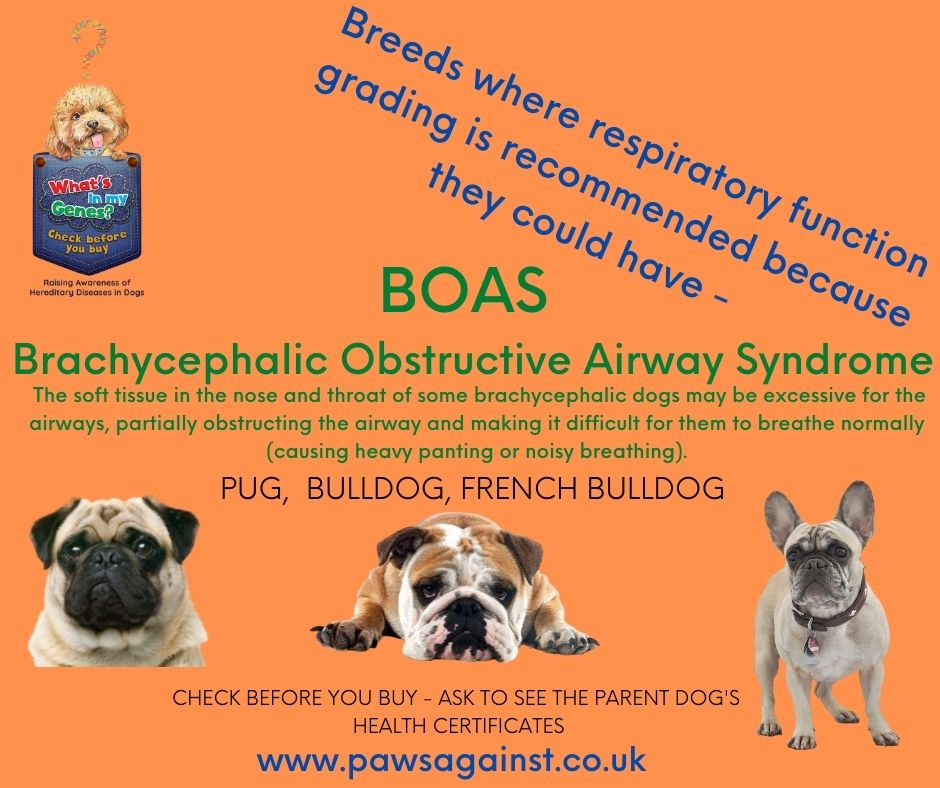
Respiratory Function Grading Scheme ( KC & University of Cambridge) BOAS
The Kennel Club and University of Cambridge’s Respiratory Function Grading Scheme assesses Bulldogs, French Bulldogs and Pugs for a breathing problem known as BOAS (brachycephalic obstructive airway syndrome).
What is BOAS?
Dogs with a flat, wide-shaped head are said to be brachycephalic (‘brachy’ meaning short, and ‘cephalic’, meaning head). The soft tissue in the nose and throat of some brachycephalic dogs may be excessive for the airways, partially obstructing the airway and making it difficult for them to breathe normally (causing heavy panting or noisy breathing). This condition is known as BOAS and is a progressive disorder that can impair a dog’s ability to exercise, play, eat and sleep.
Information about the Brachycephalic Working Group can be found here: http://www.ukbwg.org.uk